Noun (Basic ㊦ 503)
An intention or conviction of a speaker (or a person with whom the speaker can empathise) about his future or past actions or current state.
Equivalent: Intend to ~; be convinced that ~; believe; feel sure that ~; be going to; mean
| (i) Vinformal | つもりだ | |
| {話す /話した} つもりだ | Intend to talk/someone is convinced he talked | |
| (ii) Adjective い informal nonpast | つもりだ | |
| 強いつもりだ | Someone is convinced that he is strong | |
| (iii) Adjective な stem | なつもりだ | |
| 元気なつもりだ | Someone is convinced that he is healthy | |
| (iv) Noun | のつもりだ | |
| 先生のつもりだ | Someone is convinced that he is a teacher |
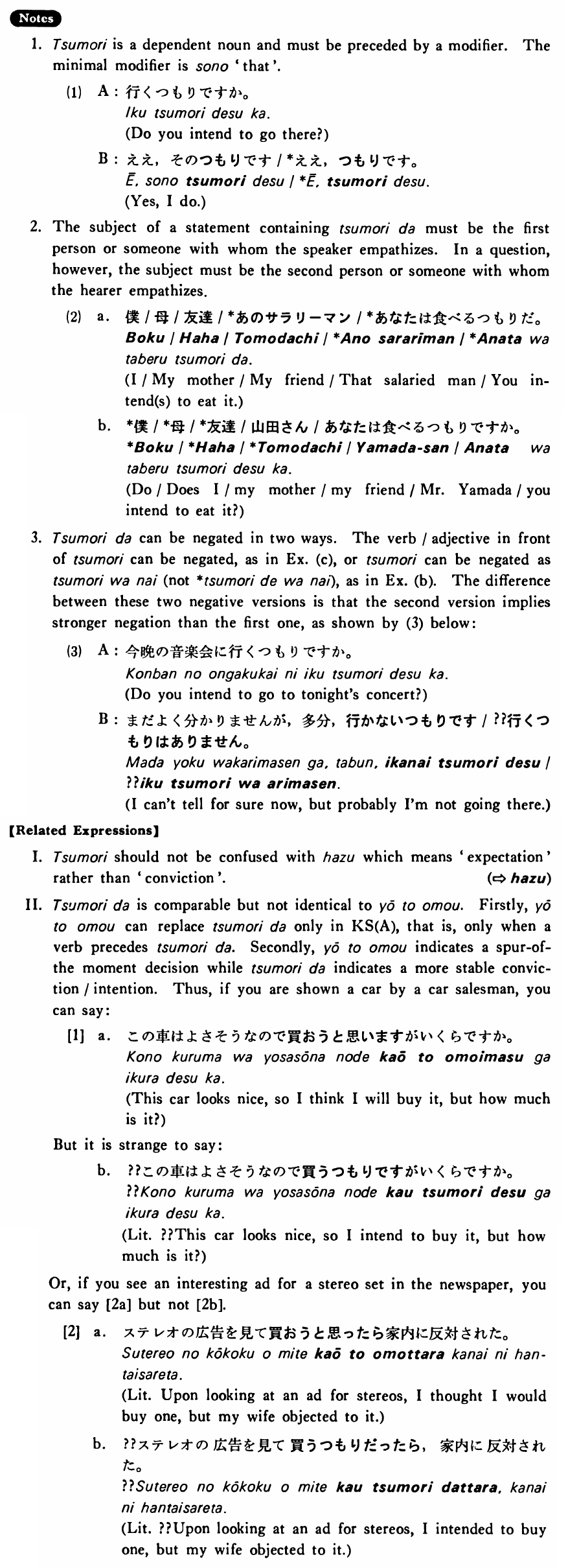
1. つもり is a dependent noun and must be preceded by a modifier. The minimal modifier is その 'that'.
2. The subject of a statement containing つもりだ must be the first person or someone with whom the speaker empathizes. In a question, however, the subject must be the second person or someone with whom the hearer empathizes.
3. つもりだ can be negated in two ways. The verb/adjective in front of つもり can be negated, as in Example (c), or つもり can be negated as つもりはない (not *つもりではない), as in Example (b). The difference between these two negative versions is that the second version implies stronger negation than the first one, as shown by (3) below:
【Related Expressions】
I. つもり should not be confused with はず which means 'expectation' rather than 'conviction'.
(⇨ はず)
II. つもりだ is comparable but not identical to ようと思う. Firstly, ようと思う can replace つもりだ only in Key Sentence (A), that is, only when a verb precedes つもりだ. Secondly, ようと思う indicates a spur-of-the moment decision while つもりだ indicates a more stable conviction/intention. Thus, if you are shown a car by a car salesman, you can say:
[1]
But it is strange to say:
Or, if you see an interesting ad for a stereo set in the newspaper, you can say [2a] but not [2b].
[2]